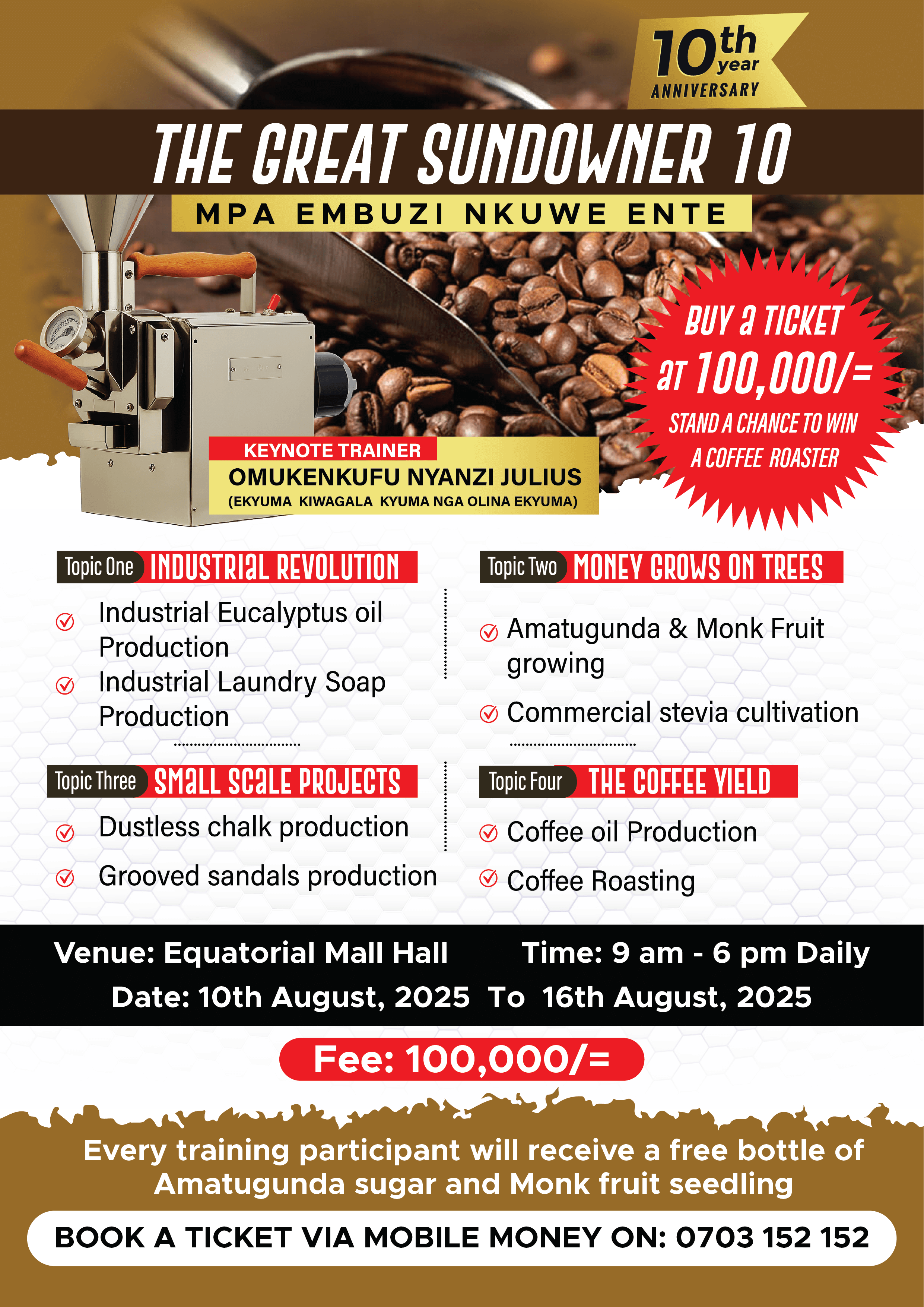
Omukenkufu Nyanzi Julius: Building Africa Through Ideology, Industry and Strategic Wealth Creation
According to Omukenkufu Nyanzi Julius, Africa’s future will not be secured by strong military establishments alone. Lasting national strength, he argues, must also be built upon ideology, innovation, industrialization, discipline, productivity, and strategic wealth creation.
At the centre of this philosophy are three major ideological pillars that Omukenkufu Nyanzi Julius has consistently advanced as practical pathways toward economic independence, national productivity, and socio-economic transformation.
Iron Sharpens Iron — “Ekyuma Kiwagala Kyuma”
The first pillar, Iron Sharpens Iron — “Ekyuma Kiwagala Kyuma,” places industrialization at the centre of national development.
The philosophy emphasizes mechanization, manufacturing, technology transfer, skills development, and the establishment of strong local industries capable of converting Africa’s abundant natural resources into finished products.
For Omukenkufu Nyanzi, exporting raw materials while importing expensive finished products limits Africa’s ability to create sustainable wealth.
His argument is that true economic transformation begins when Africans develop the machinery, knowledge, skills, and enterprises necessary to process what they grow and extract.
Coffee should not end at the coffee bean.
Herbs should not end as harvested leaves.
Oil seeds should not end as agricultural produce.
Timber and trees should not remain merely raw materials.
They can become oils, medicines, cosmetics, foods, beverages, soaps, industrial products, and other manufactured goods.
The philosophy therefore calls for a transition from consumption to production, from raw materials to manufacturing, and from dependency to productive capacity.
Ssente Zimera Ku Miti — “Money Grows on Trees”
The second pillar, Ssente Zimera Ku Miti — “Money Grows on Trees,” presents agriculture, indigenous herbs, trees, research, and value addition as important foundations for sustainable wealth creation.
The ideology challenges the traditional perception of agriculture as merely a subsistence activity.
Instead, agriculture should be approached as a sophisticated commercial and industrial enterprise capable of creating jobs, generating exports, producing industrial raw materials, and building household and national wealth.
Africa possesses vast biological resources, including medicinal plants, aromatic trees, fruits, seeds, coffee, herbs, and other valuable crops.
The philosophy of Ssente Zimera encourages Africans to combine these resources with science, research, technology, and entrepreneurship.
The tree, therefore, becomes more than a tree.
A eucalyptus tree can become essential oil.
Coffee can become beverages, cosmetics, and coffee oil.
Medicinal plants can become standardized herbal products.
Seeds can become virgin oils.
Agricultural crops can become processed foods and industrial products.
The wealth, in this philosophy, does not simply lie in owning natural resources. It lies in understanding how to transform those resources into products of greater economic value.
Give a Goat! Get a Cow!
The third ideological pillar, “Give a Goat! Get a Cow!”, focuses on strategic growth, reinvestment, and the multiplication of productive assets.
Its message is simple but powerful: economic progress does not always require beginning with enormous capital.
A person can begin with something small and deliberately transform it into something bigger.
The philosophy encourages individuals, families, and communities to identify the resources already within their reach, invest them wisely, generate returns, and continuously reinvest those returns into larger opportunities.
A goat can become a cow.
A small machine can become a production line.
A small farm can become a commercial enterprise.
A small business can become an industry.
The principle therefore promotes patience, financial discipline, reinvestment, enterprise development, and progressive wealth accumulation.
Instead of waiting indefinitely for perfect conditions or large amounts of capital, people are encouraged to start with what they have and deliberately build upward.
A Broader Vision for Africa
Together, the three philosophies form a wider development framework centred on production, industrialization, agriculture, innovation, value addition, and strategic wealth creation.
Iron Sharpens Iron asks Africa to manufacture.
Money Grows on Trees asks Africa to recognize and commercialize the wealth within its natural resources.
Give a Goat! Get a Cow! asks Africans to multiply whatever productive assets they already possess.
The philosophies converge around one central idea: Africa cannot achieve lasting prosperity merely by possessing resources. It must develop the knowledge, technology, discipline, and enterprises required to transform those resources into wealth.
Omukenkufu Nyanzi Julius maintains that the strength of modern nations will increasingly depend not only on their military capabilities or political institutions, but also on their ability to produce, innovate, manufacture, commercialize knowledge, and build productive wealth.
His teachings have increasingly attracted interest among young people, entrepreneurs, farmers, innovators, and leadership circles because they emphasize practical economic participation rather than passive expectations of development.
At the heart of the philosophy is a call for a new African mindset — one that sees opportunity in agriculture, machinery, science, indigenous knowledge, manufacturing, and entrepreneurship.
The message can ultimately be summarized in one transformation:
From consumption to production.
From raw materials to value addition.
From subsistence to enterprise.
From small assets to greater assets.
From potential to productive wealth.
For Omukenkufu Nyanzi Julius, this is not simply an economic programme.
It is a philosophy for building a productive Africa.